
The Costume Is Not the Art
On masquerade, performance, and the problem of preservation
The masquerade is one of the most misread cultural forms in Nigeria. It is treated, most often, as an object — a costume, a face, a body in motion — when it is more accurately a system. What the masquerade produces is not just spectacle, but community. The costume is the outermost expression of a social construct that includes cosmology, governance, collective memory, and the management of relationships between the living and the dead. This expression is carried on the knowledge moving between those who understand what is being enacted and those who are only beginning to learn. The masquerade, observed this way, is not a thing made by a community. It is a thing that makes community.
To document the masquerade without documenting that system is to record the delivery and ignore the message. This is why archiving these traditions presents a problem that purely visual documentation cannot solve.
It Is Theatre
The Nigerian masquerade tradition is theatre. In the full structural meaning of the word — with dramaturgy, audience, catharsis, spectacle, and narrative. With roles and conventions and a body of accumulated knowledge about how a performance is to be conducted and received.
The Egungun tradition of the Yoruba makes this legible most directly. Egungun is ancestor theatre. Costumed performers become conduits for the dead — the ancestral voice speaking to the living through elaborately layered cloth and ritual. There is a script, even if unwritten. There is a cast, even if membership is hereditary and spiritually governed. There is an audience that knows how to be an audience: what to approach, what to retreat from, what to receive in silence and what to answer with collective voice. The performance has a beginning, a middle, and an end. It has something at stake.
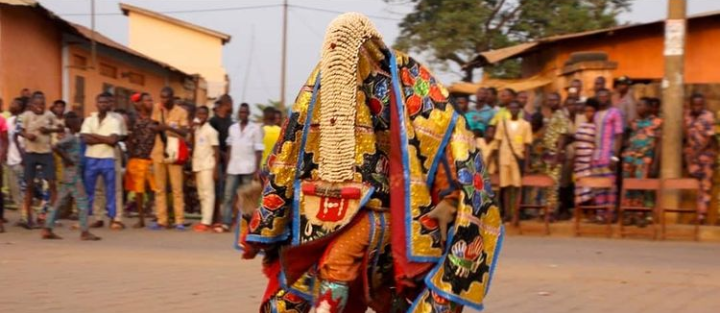
The Ekpe and Ekpo societies of the Cross River basin operate at a more complex register still. Here the masquerade functions simultaneously as governance, judicial process, and performance. The masked figure does not represent power symbolically — it is power, given a body and made visible. The line between the theatrical and the administrative does not exist, because in this tradition the two were never separated.
The costume, the movement, the sound — these are not the art. They are the delivery system. The art is cosmological.
This is the point that cannot be conceded in any serious discussion of preservation: the story is the foundational and final layer of the costume. Strip the cosmological world that generates the performance, and what remains is aesthetics without argument. Spectacle without stakes. An object of considerable beauty and no content.
Broadway did not survive as an institution because someone decided to preserve its costumes. It survived because an entire apparatus was built around it — rehearsal traditions, notation systems, schools, criticism, a paying audience class, patronage networks. The art form did not freeze. The infrastructure around it became robust enough to carry it forward. The question that masquerade traditions now face is whether that kind of apparatus can be built without destroying the thing that makes the art necessary in the first place.
What Failed Export Looks Like
There is a historical record of what happens when African performance and visual culture travel without their epistemological context, and it is not encouraging.
The Benin bronzes represent the most famous case, and also the most literally violent — objects removed by imperial force, meaning stripped alongside physical presence. But the more instructive case may be what happened in early twentieth-century Paris. When Congolese and Gabonese masks entered the studios of Picasso, Braque, and the Fauvist painters, they entered a world with no framework for receiving them as what they were: devotional objects, cosmological arguments, concentrated expressions of a complete worldview. What Paris saw instead was formal innovation — the fractured plane, the geometric reduction, the disturbing frontality. The masks became grammar for a European aesthetic revolution.
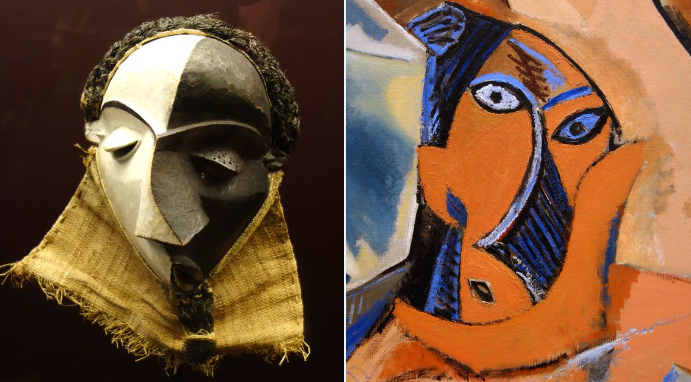
That revolution was genuine. The work Picasso produced after his encounter with African objects at the Trocadéro in 1907 changed Western art history. But what was evacuated in the transaction was everything the objects actually were. The Fang and Kuba cosmologies that generated them did not travel. The ancestor relationships they embodied did not travel. The ritual contexts in which they acquired their power did not travel. What arrived was surface, and surface was sufficient for what Europe needed.
This is not a historical grievance alone. It is a structural warning about what happens when export occurs without intention. The object survives the crossing. The meaning does not. Export that does not plan for the soul will always deliver only the costume.
But It Has Been Done
The counter-evidence is Candomblé.
Yoruba religious and performance tradition crossed the Atlantic under the worst possible conditions. The Middle Passage, the plantation, the systematic destruction of African cultural memory, And yet there are Candomblé houses in Salvador da Bahia today whose ritual knowledge traces directly to Yoruba source traditions. The orixás survived the crossing with their personalities, their colours, their ritual requirements, their relationships to one another intact. Not perfectly; not without syncretic adaptation. But recognisably. The soul made the journey.
It survived because the community, however partially and under whatever duress, travelled with the practice. Knowledge was kept alive in the body, passed person to person under conditions that made written transmission impossible. The outer forms adapted — absorbed Catholic saints, learned to hide — while the inner logic was protected. The tradition survived not by being frozen but by being lived.
Japan offers a different model. The Noh theatre tradition is ancient, formally rigorous, metaphysically serious. It became UNESCO-listed, heavily institutionalised, state-supported. It did not become spectacle. It became monument — a condition with its own problems, its own risk of calcification — but it demonstrates that the path of formalisation is not automatically fatal to depth. Noh maintained its philosophical weight through institutionalisation, which means the process is not the enemy. Thoughtlessness is the enemy.
There were native attempts closer to home that almost caught. Duro Ladipo built a Yoruba operatic tradition in the 1960s that drew directly on the cosmological world of masquerade and orisha performance. Hubert Ogunde created an audience for Yoruba popular theatre that, at its height, could sustain a professional company. Neither tradition was ever fully institutionalised. The infrastructure never caught up. What remains is evidence of what was possible, not the thing itself. The failure was not artistic. It was structural.
The soul is more portable than the anxiety around preservation tends to assume. The evidence says so. What portability requires is intention, infrastructure, and an absolute refusal to mistake the surface for the substance.
The Production Kit
The most urgent work is not performance. It is documentation of a specific and demanding kind. What is typically archived when cultural performance traditions are recorded is the visible layer: costume materials and construction techniques, movement vocabulary, musical structures. These matter. But they are the delivery system, not the art. An archive that captures only the delivery system produces, at best, material for powerful museum exhibitions. At worst, it provides the raw material for the next generation of Trocadéro encounters; surface available for aesthetic extraction, soul nowhere in the record.
What must be archived alongside the visual and performative is the cosmological. The story infrastructure. Who are these figures, understood within the complete belief system that generated them? What does this masquerade’s appearance mean? — not symbolically in the flattened way we use symbols, but ontologically, in the world where this performance is true. What does the community know when they watch, that the outside observer does not? What is the knowledge that must travel with the performance in order for the performance to remain itself?
This is harder to document. It demands access that visual documentation does not require. It requires relationships with knowledge-holders who may have principled reasons to withhold. It calls for an archival sensibility that treats explanatory context as primary, not supplementary. And it requires, ultimately, a production kit designed for exporters — a package of sufficient richness that anyone bringing this tradition to a new context holds in their hands not just the costume and the choreography, but the argument the performance is making, the world it comes from, the questions it is answering.
The archive is the infrastructure that did not exist when it was needed. It can be built now. That is the contribution worth making.
Why It Must Be Tried
There is a coherent argument for leaving these traditions alone. It holds that the masquerade is rooted in specific soil; that its stories derive their power from communities that hold them as true, not merely as narrative; that formalisation and the apparatus of professional theatre bring with them audiences who do not share the cosmological world of the performance, and that performing for those audiences changes the performance. The ritual becomes the representation of a ritual. The living tradition becomes the exhibition of a living tradition.
This argument deserves respect. It is not wrong about the risk. There are masquerade performances staged for tourists today that carry the texture of their source traditions without their substance. Technically correct, spiritually empty. The warning is real, and any serious preservation effort must hold it in view. But the alternative is a slower disappearance, and the disappearance is already underway. Urbanisation pulls the young away from the communities that carry the knowledge. The appetite for collective performance is reorganised by television and digital media. Knowledge-holders age. The troupes that survive operate on a fraction of the social and economic support that once made them central to community life. Leaving these traditions entirely untouched is not preservation.
The difficulty of doing this well is not a reason to avoid it. It is the description of the task. The question is not whether to attempt the export, but whether to attempt it carefully, with enough understanding of what the soul of these traditions actually consists of that what arrives on the other end is not specimen.
The costume is not the art. The story is. And the story, given the right infrastructure, can travel correct.