
NIGERIAN ROYALTY SERIES
Afonja of Ilorin
Are-ona Kakanfo of the Oyo empire · c. 1750–1823 South-West Zone · Ilorin· Ancient Oyo Empire
Afonja was the sixth Are-Ona-Kakanfo — the supreme military commander — of the Oyo Empire, and the hereditary Baale of Ilorin, a frontier military camp on the banks of the River Awun in what is today Kwara State. Afonja was no ordinary war leader. His lineage ran deep in Ilorin’s history. His great-grandfather, Laderin, founded the city of Ilorin. Laderin’s son, Pasin, emerged as a powerful warrior whose rising influence alarmed Basorun Gaha, the dominant political figure of his era.
Gaha perceived Pasin as a threat, forced him into exile, and Pasin was eventually killed. Leadership in Ilorin passed to Pasin’s son, Alugbin, who became Baale. Upon Alugbin’s death, Afonja assumed leadership. The lineage of Laderin, Pasin, Alugbin, and Afonja constituted the only Yoruba rulers Ilorin would ever know.
He came of age in the late 18th century during the decline of Alaafin Abiodun’s reign, a period when provincial military commanders had grown powerful enough to make and unmake kings. His kinship ties to the royal palace at Oyo-Ile ran deep — he was reportedly born in the palace — yet the Oyo-Mesi’s refusal to consider him for the Alaafin’s stool would ultimately prove the wound from which all else bled.
The narrative of Afonja cannot be understood without the other two men who defined it: the Alaafin he destroyed, and the cleric who destroyed him.
Alaafin Aole (Awole)
When Alaafin Abiodun died in 1789, the Oyo Empire stood at a dangerous crossroads. His death marked the end of an era of relative stability and the beginning of internal fractures that would ultimately dismantle one of the most powerful empires in West Africa. Installed after Abiodun was his cousin, Alaafin Aole (also known as Awole).
Aole ascended the throne in 1789. A cousin of the late Alaafin, Aole was described to be tall and handsome but perceived as politically weak and lacking the firmness and political strength required to govern a vast and complex empire. He had been installed by the Oyo-Mesi precisely because they believed he could be controlled. What followed was a cold war of mutual suspicion between Aole and Afonja, both products of the same palace. Aole’s reign reportedly soon became notorious cultivating an empire plagued by cruelty, treachery, and tyranny. People were enslaved for minor offenses, citizens had little to no rights and fear replaced justice. Traditional oaths sworn in the names of the gods were abandoned, and the chilling phrase: “May the King’s sword destroy me.” soon took higher precedence.
The crisis erupted through a sequence of provocations. As custom demanded, the newly installed Alaafin was asked to name his first enemy for a military expedition. Aole named Iwere-Ile, an impregnable town which also happened to be the hometown of a former Alaafin’s mother. Such a mission was bound by sacred oath to bring ruin to any Kakanfo who attempted it. Afonja discovered it was a conspiracy to send him on a suicidal mission and refused.
Then came the order to sack Apomu, a prosperous market town located in Olowu territory. Apomu was a major commercial hub patronized by traders from Oyo, Ife, Owu, and Ijesa. The choice was deeply personal. Years earlier, while still a private citizen, Aole had sold a close friend into slavery at Apomu market. When the village head discovered that an Oyo citizen had been enslaved, he ordered the man’s release and repurchase. This public humiliation enraged Aole. When war was declared, Afonja complied, but on the march home he turned his army toward Oyo-Ile itself.
In alliance with Basorun Asamu Agba-o-lekan and Owota of Oyo, he turned against the Alaafin. Oyo city was besieged for weeks and an empty covered calabash was sent to Aole. In the language of Oyo ritual, this meant only one thing: the Alaafin had been rejected by the people, and was required to take his own life. Aole obeyed, but before dying, he performed a curse that many historians regard as one of the most consequential acts in Yoruba history.
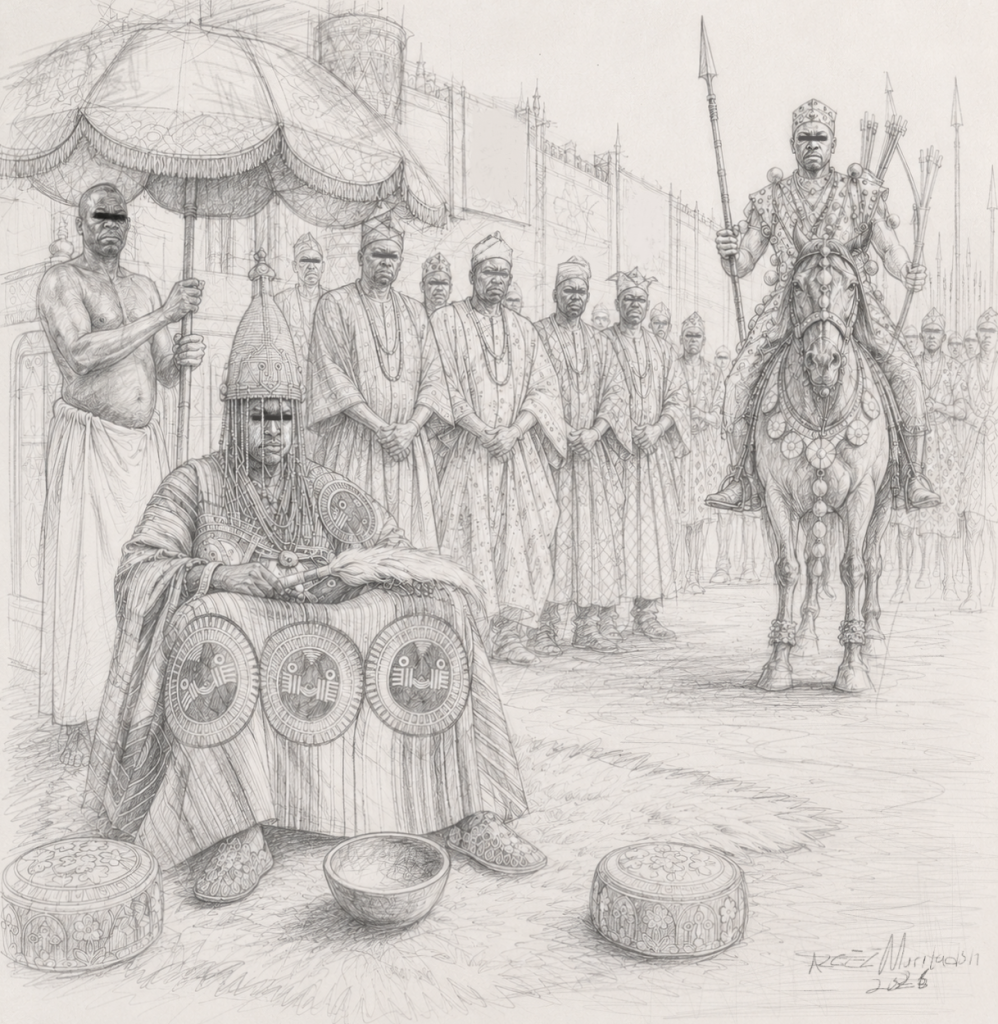
The Curse of Aole Before his death in 1796, Alaafin Aole shot three arrows into the air — one to the north, one to the south, one to the west — and cursed all Yoruba people: that their children would be sold into slavery across the world. Many scholars trace the catastrophic wave of Yoruba enslavement and inter-tribal wars that followed — the Kiriji War, the Ijaye War, the Egba-Dahomey War — to the fracture Afonja set in motion that day. |
After deposing Aole, the Oyo empire began to fracture. The newly installed Alaafin, Adebo, was largely a ceremonial king, powerless in the face of provinces who had began asserting their independence. The Alaafin’s orders were ignored, chiefs turned their might on the people, and the authority of a once mighty empire gradually became a subject of ridicule. Having been passed up again for the crown, Afonja returned to Ilorin and set about building an independent city-state. He expanded the town’s territory, absorbing surrounding towns including Elehinjare, Ganmo, Idofian, Kanla, Oke-Oyi, Igbon, Iresa Ibare, amongst other neighbouring settlements. He then allied with a Fulani Islamic scholar named Shehu Alimi who had settled in Ilorin with his followers that included a substantial population of Hausa slaves who were coopted into Afonja’s army. The alliance seemed advantageous: Alimi brought spiritual authority and military muscle; Afonja brought political legitimacy and territorial control.
Afonja consolidated power further by bringing major military commanders under his supreme command. Toyeje, the Baale of Ogbomosho, commanded the right wing; Fagbohun, the Baale of Jabata, led the left. He also invited Solagberu, a wealthy Yoruba ally, who settled on the outskirts of the fast growing city of Ilorin. The city grew rapidly following the policies Afonja instituted. Broad freedoms and protection to Muslims and persecuted slaves across Oyo territory drew large numbers of Hausa, Nupe, Bariba, Aja, and Fulani slaves to Ilorin. Many joined Afonja’s army willingly, driven by resentment against former masters. Together with the other muslim forces mobilized by Solagberu, the group identified themselves as the Jamas.
Back in Oyo, the fracture had started manifesting tangibly. Several skirmishes between chiefs and power players fueled by vendetta and politics sprung up, eliminating many of the Oyo chiefs and ultimately led to Afonja being the dominant power. Kings ruled locally, but his Jamas turned into marauders, looting property and terrorizing civilians. Former slaves returned to oppress their previous masters. But Afonja had built his new army on a fatal miscalculation: The Jamas, a growing Islamic brotherhood swore loyalty not to him but to the faith. When Alimi died and his son Abdulsalam inherited leadership of the Jamas, the balance collapsed entirely.
When Afonja finally recognised the threat and moved to dissolve the Jamas, it was too late. He called on his old ally Solagberu for help. None came. Surrounded in his own compound, Afonja was killed and his body burned to ashes — perhaps around 1823. Abdulsalam declared himself Emir of Ilorin, pledged allegiance to the Sokoto Caliphate, and Ilorin passed permanently out of Yoruba hands.