I have a love-hate relationship with Makoko. On the one hand, the contextual adaptation of community and terrain that has now worked for several decades has proven to be artisanally sustainable and offers rich data for progressive development towards environmental and socio-cultural sustainability. This I love. On the other hand, I still find it difficult to accept that life on the community level cannot be better. I must admit the detachment that privilege affords me to be able to say this, but in the little interaction I have had with a sample of the community, there’s an apparent consensus to maintain a tough ceiling on development within the community. This I hate. However, the place of conversations like this is to open the understanding beyond personal biases or rationalizations, and consider the multidimensionality of the stories that flow within and through these types of settlements. Considering the state of the city, there are probably several things that will motivate the community to keep a tight leash on certain types of development, for good reasons as well as bad. In Lagos especially, where the only developments that tend to happen are mercilessly gentrifying, it’s not difficult for development paranoia to set in amongst people who have this community — no matter what anyone thinks of it — as their only place in the world.
While I may try to balance these poles in my personal consideration, general discourse tends to be less accommodating of the relativity and nuance of the subject. This is all the more so with the overwhelmingly uniformized public perception of the community on both sides of the spectrum — the purists, who cannot see beyond the slum, or the tourists who romanticize the experience — and this, I think, is the gap the recent collection by Damilola Opedun fills quite spectacularly.
The purpose of an art practice, in my opinion, is to pick a subject — a story — and investigate, examine, and present the multiple dimensions of that subject visually, so it can be impressed a bit deeper with the audiences to whom that subject is relevant. This is my curatorial approach. Opedun’s art practice has sat with this subject of Makoko for a while, and it’s evident in the narrative depth of this new collection, aptly titled The Witness. The show holds the poles of this conversation in such a delicate balance that it allows a fresh wave of clarity in engaging with the discussion. The aspects of “what is” and “what could be” are both held with a calculated reverence that gives neither more nor less than its deserving weight. I particularly appreciate that the center of his narrative is not just the community as a social or urban component, but community as an individual. I see this in the visual and narrative direction — using the architectural landscapes of the lived and known reality to construct dreamscapes that describe what the psychomental landscape of the individual that is the community should be.
In terrain-influenced communities like Makoko, what defines the individual in the community is the community within the individual, and individual stories are often overshadowed by the singular narrative of the community. Here, the danger of a single story is viscerally experienced — the narrative defined by the environment is so entrenched and overarching that the path of the individual is mandated to be secondary. This narrative is imposed by both environment and culture on every inhabitant, and it takes a significant amount of will to self-determine a different path. Without discounting the harshness of the lived reality, Damilola Opedun offers material to consider and dream beyond the presupposed trajectory of the established story. His work touches on the quality of presence regardless of the particular condition of the present — a timeless message that the divine is not without, but within. Interestingly, this resonates on a broader level with my own philosophy, that the quality of the relationship with the divine is not a set-off ceremony requiring pilgrimage, but is hinged instead on the fidelity of the witness — regardless of time and place. This mind-frame shores up the will of the individual within the community to yet reach for God and greatness from their stead, with the assurance that God and greatness is reaching right back, right there.
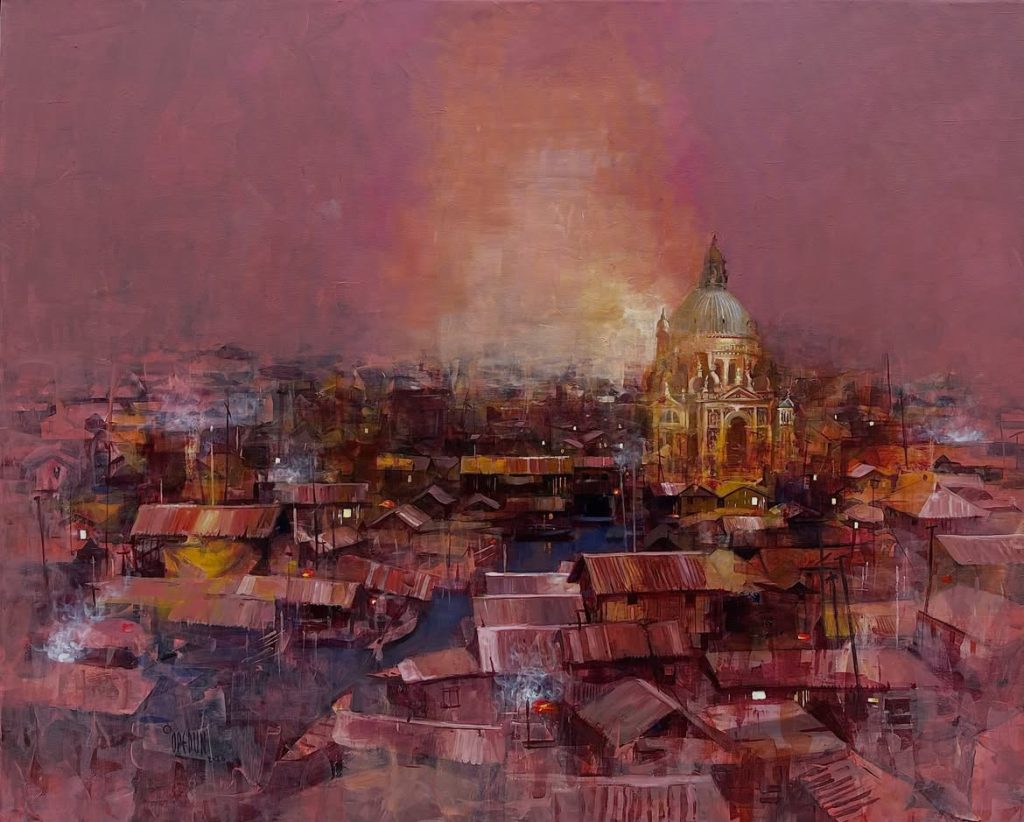
This assurance is not only asserted in language. It is legible across the four works that anchor the collection, each returning to the same skyline — the stilt houses of Makoko held beneath the borrowed dome of Santa Maria della Salute — as though a single view, held long enough, could be made to yield more than one conclusion.
In The Meeting Point I, the claim is made without qualification. The dome burns gold at the center of the canvas, ascendant, breaking through the rooftops like something arriving rather than something built. There is no distance here between the sacred and the settlement — the cathedral does not preside over Makoko so much as emerge from within it — and the implication is total: no pilgrimage, no elsewhere, no tomorrow. The chest, the hands, the canoe, the roof are already holy ground. This is “what could be” stated as though it were already “what is.”
The Meeting Point II returns to the same composition but revises its grammar. Where the first work declares, the second relates. The dome is paled to dusk-blue and gold-white, the settlement around it rendered in a nocturne that reads less like proclamation and more like waiting. Opedun’s language shifts accordingly, from is to pull, from location to longing: the altar is not arrived at, it is carried, and it draws the way it is drawn to. Presence, here, becomes relational rather than merely positional — it is not enough to say the divine is here, the work insists that it is also reaching.
Concrete Utopia is where the show’s title finds its verb. Two stone lions, foregrounded and monumental, watch over the settlement from a ledge that could belong to any colonial-era balustrade — the same species of ornament that once marked the boundary between the civilized and the wild. But Opedun’s lions have stopped roaring. They guard rather than threaten, and in his own words, the demolition, the hunger, the leaking roof become ornament rather than wound. This is witness as a practiced transfiguration, not an absence of the threatening thing but its conversion into vigilance. Tellingly, the cathedral recedes here, ghosted into the upper corner of the canvas rather than commanding its center — as if to insist that “what could be” does not require the sacred to dominate the frame. It requires only that what survived be allowed to stand guard.
It is In Between the Veil and the Mines, however, that keeps the collection honest. Here the dome is neither gold nor gone — pale, recessed, half-swallowed by a denser and more compressed rooftop line, present but obscured. Opedun’s language turns correspondingly severe: there is a mine where trauma makes its home, furnished and familiar, and there is a veil, thin but still a veil, that must be pressed through. Most of us, he admits, stand with one foot in each — comfortable in the wound, afraid of the healing. This is the confession the first two works do not make. The immanence of The Meeting Point I is true, but truth alone does not account for how difficult it is to leave a familiar pain for an unfamiliar light. This piece is the one that remembers that difficulty, and in doing so it keeps “what could be” from resolving too easily into comfort, and keeps “what is” from being read as merely bleak.
Read together rather than singly, then, the four works do not repeat a single claim so much as press on it from different angles — declaration, relation, transfiguration, confession — until what is left standing is not a slogan about the divine within, but a portrait of what it actually costs to go on believing it.
This, I think, is the real achievement of The Witness, and the answer to the gap I named at the outset. It refuses both the purist’s flattening of Makoko into a slum to be pitied and the tourist’s flattening of it into an experience to be romanticized, because it insists on a third read entirely: that the individual within the community carries a story too large for either frame, one in which suffering and transcendence, mine and veil, “what is” and “what could be,” are not opposites to be resolved but conditions to be witnessed, together, without flinching from either.