
NIGERIAN ROYALTY SERIES
Ogiso Orroro
Alt. 'Orhorho'. 8th Ruler of Igodomigodo · r. c. 600–618 CE South-South Zone · Edo · Ancient Benin Kingdom
Before there was a Benin Kingdom in the sense the world now knows it — before the great Bronzes, before the moats whose scale the 1974 Guinness Book of Records described as the largest earthworks built prior to the mechanical era, before the punitive expedition of 1897 and the dispersal of the artworks into Western museums — there was Igodomigodo. The land of the Ogisos. The title Ogiso derives from two Edo words: Ogie, meaning king or ruler, and Iso, meaning sky. The compound translates most directly as King of the Sky, though the Edo understanding was richer than translation allows. The Ogiso was not merely a king who happened to be named after the sky; the title encoded a cosmological claim. The ruler was understood to have descended from, or to be continuously connected to, the divine order above. It was believed that their authority was beyond human arrangement; that their heritage was cosmic ordinance.
Traditions credit the Ogisos with mythical powers. They appear in folk tales as figures who speak with animals, who match wits with Egui the trickster tortoise, who travel between the visible and invisible worlds. Governance and metaphysics were not separated in this system. The ruler was simultaneously political head, spiritual intermediary, and living embodiment of the social order’s legitimacy. A woman who held this title was not a curiosity or an exception — she was, by definition, someone the community recognized as the living point of connection between Igodomigodo and the cosmos.
The Benin history project records Orroro as the eight Ogiso and she immediately follows Emose, the seventh, who is also believed to be female. This consecutive female succession is one of the most extraordinary facts in Nigerian royal history and one of the most completely ignored. Two women, ruling in sequence, holding the title of King of the Sky — not as a regent or a consort, but as the supreme political and spiritual authority of their land. Emose’s reign is dated to have lasted sixteen years, and Orroro’s reign lasted eighteen. If these dates are accepted, the Edo people were governed by women for at least thirty-four consecutive years during the Ogiso period. In the oral record, the transition between them appears to have been unremarkable. There is no tradition of Orroro’s succession being contested on grounds of her sex. She came to power as a matter of legitimate succession.
By position eight in the Ogiso sequence, the kingdom of Igodomigodo had already been through significant institutional development. The first Ogiso, Igodo (also called Obagodo), had united various chiefdoms and established the principle of centralised rule. His successor Ere had introduced the foundational regalia of Edo kingship — the ekete (royal throne), the agba (rectangular stool), the ada and eben (ceremonial swords) — and had established the first market. Successive Ogisos had created the title structure of the state, established the army, undertaken currency reform, and expanded the polity’s reach through the system of prince-governors. By the time of Emose and Orroro, Igodomigodo was a functioning, institutionally sophisticated polity — not a large empire, but a coherent state with established customs, a professional administrative class, and a settled cosmological framework. Orroro was not ruling a tribe; she was ruling a kingdom, and she did so from within a governing tradition that had been accumulating complexity for generations. Her philosophical identity must be understood in that context: the Ogisos were expected to be not merely strong but wise. Governance in the Ogiso tradition was an intellectual exercise as much as a political one.
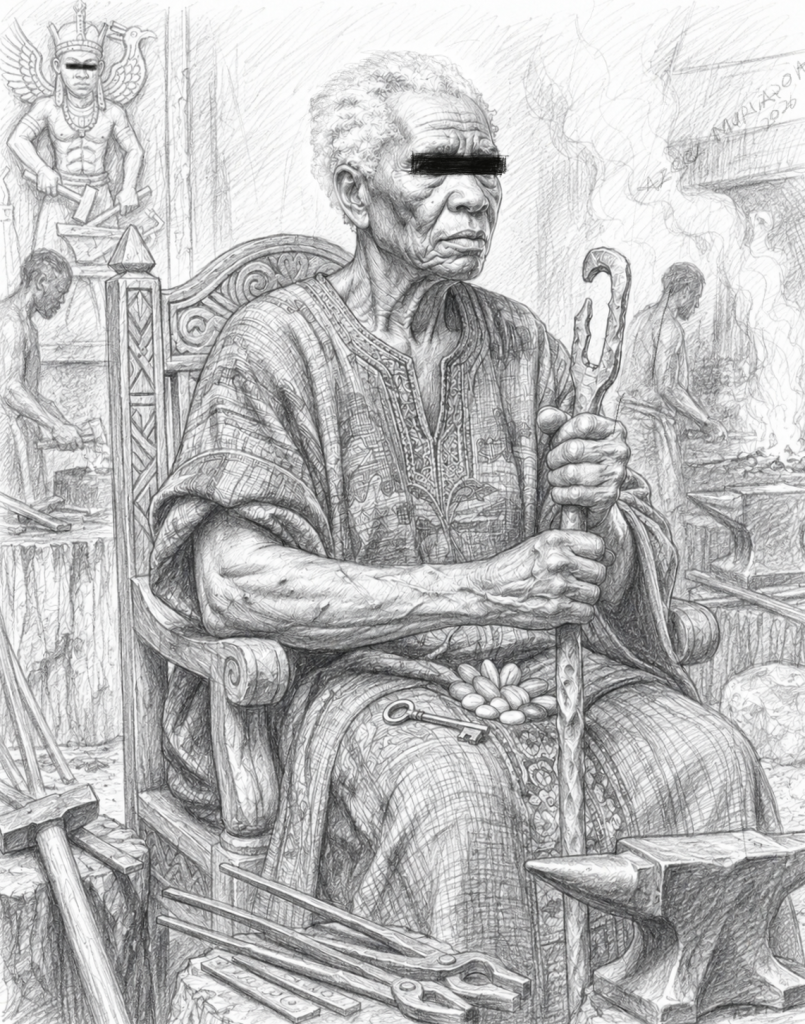
The oral record on Orroro reduces, at its most distilled, to three claims. She was a blacksmith. She was a philosopher. She died at ninety-eight, holding iron in her hand. These three facts are transmitted consistently across the sources that mention her, which suggests they survived the oral transmission process because they were considered central to who she was — not ornamental detail but essential identity.
That Orroro was a blacksmith must be understood in its full dimension. Blacksmithing in pre-colonial West African societies was not primarily an economic category. It was a spiritual one. The blacksmith worked at the intersection of the natural and the transformed — taking ore from the earth and, through fire and skill and specific ritual practice, making it into something that had not existed before. This transformation was understood as analogous to the divine act of creation itself. Across West Africa, the forge and the smith occupy a sacred position. Among the Yoruba, this is the domain of Ogun — deity of iron, war, labour, and the clearing of paths, one of the most powerful and widely venerated Orisha in the Yoruba pantheon. Among the Igbo, Aja-ala and related earth-connected deities govern the ground from which iron is extracted. In the Edo tradition specifically, iron and metalwork would go on to become the supreme artistic and spiritual expression of the Benin Kingdom — the Bronzes, the sacred altars cast in brass and copper, the entire visual vocabulary of divine kingship encoded in metal. Orroro stands at the origin of that tradition.
A woman who is both King of the Sky and a working blacksmith is a figure who embodies two apparently separate domains of power — the celestial and the elemental. The Ogiso governs from above; the blacksmith works at the level of the earth, in fire, with ore. In Orroro, these domains merge. She is the sky that comes down to work with its hands. She is the divine ruler who understands that creation is physical labour, that sovereignty is not remote from the making of things but continuous with it. The blacksmith’s relationship to iron also has a martial dimension. Iron makes weapons. The forge is where warfare becomes possible. A ruling monarch who is also a blacksmith holds a particular kind of authority — she is not only the one who commands the army but the one who theoretically understands the making of what the army carries. This conflation of political authority with material production at the point of the forge is not simply symbolic; it is a claim about the nature of power itself.
The fusion of blacksmith and philosopher in a single figure is not as paradoxical as it first appears. In many African philosophical traditions, the division between contemplation and making does not hold in the same way it does in Western intellectual history, where the vita contemplativa was separated from — and ranked above — manual labour. In the Edo and broader Niger Delta context, wisdom was expected to be practical. A philosopher who could not also forge was perhaps only half a thinker. Orroro’s double identity suggests a ruler whose authority was total in the sense of being undivided. She thought and she made, and these were understood as a single activity.
Orroro ruled for eighteen years. This was a full, settled tenure by any historical standard. There is no tradition of a succession crisis during her rule, no record of rebellion or delegitimisation. She held the title of Ogiso for eighteen years, which means she governed the state, led the Uzama council, received tribute, managed relations with surrounding communities, and performed the ritual duties of the sky-king for nearly two decades. Her reign was not an interruption in Igodomigodo’s history; it was a chapter of it. The length of the reign is relevant to the NRS because it argues against any reading of Orroro as a transitional or ceremonial figure. She reigned as Ogiso for eighteen years, which is longer than many of her male counterparts in the list. The oral tradition did not remember a short, qualified reign; it remembered a full one.
She died, at ninety-eight, holding iron in her hand. A woman who was both Ogiso (the supreme political-spiritual authority) and blacksmith (the supreme material authority) was a figure in whom two kinds of power converged. This was not a dilution of either power — it was their amplification. The sky came down to the forge. The divine expressed itself through craft. Sovereignty was demonstrated not only by decree but by making.