NIGERIAN ROYALTY SERIES
Muhammad al-Kanemi
Shehu of Kanem–Bornu · c. 1776–1837 North-East Zone · Bornu
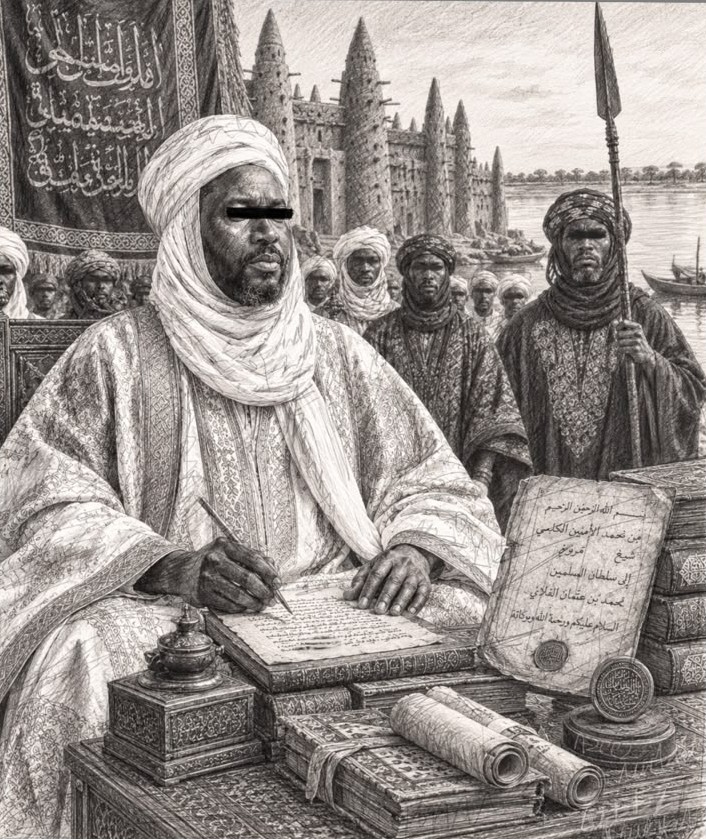
Muḥammad al-Amīn ibn Muḥammad al-Kānamī; nicknamed Laminu, is the most consequential non-sovereign in the Northeast zone and arguably one of the most significant figures in Nigerian pre-colonial history who carries no king’s title. He was a wandering scholar who arrived in Bornu with a small group of students and a reputation built on prayer. He left a dynasty whose current head still reigns. In the two decades between his arrival and his death, he saved the oldest surviving state in sub-Saharan Africa from annihilation, ended the eight-hundred-year Sayfawa dynasty without formally replacing it, fought a war of ideas against the era’s most powerful Islamic reform movement with letters instead of only swords, and built a city from nothing that served as Bornu’s capital for nearly a century.
He never took the title of Mai. He called himself only Shehu — Sheikh, teacher. But he had his own seals struck, he directed the appointment and removal of Mais at will, he engaged foreign powers on equal terms, and he was described by the only European eyewitnesses to meet him as the embodiment of civilised authority. His tomb is in Kukawa. His son formally ended one of the longest dynasties in recorded history. The Shehu of Borno holds his title today.
The Life in Phases Phase 1 — Formation Across Three Worlds (1776–c.1799)Al-Kanemi was born in Murzuk in the Fezzan — present-day southwestern Libya — to a Kanembu mallam father from the village of Fahi in Kanem Province, and an Arab mother, the daughter of a wealthy trader from Fun. His origins were therefore explicitly intercontinental: West African scholarly lineage on one side, North African Arab commercial wealth on the other. This hybridity would define his strategic intelligence for the rest of his life. He was educated first in Murzuk, where he studied the Quran. He then traveled to Tripoli to pursue advanced Islamic studies under recognised scholars. In the 1790s he accompanied his father on the Hajj to Mecca. His father died in Medina during the pilgrimage — al-Kanemi remained in the Middle East for nearly a decade, deepening his knowledge of Islamic theology, law, and jurisprudence at the heart of the Islamic world. This extended period in the Arabian Peninsula gave him the scholarly credential that would later make it impossible for the Sokoto jihadists to dismiss him as simply uninformed. On his return journey toward Kanem and Bornu, he settled in Ngala — a town on the western margins of the Kanem-Bornu Empire, near Lake Chad — where he established a growing community of students and followers, married a local ruler’s daughter (strengthening his political standing), and was joined by two Shuwa Arab scholars he had met during his travels. He arrived in Bornu around 1799 as a wandering scholar with a following but no official position — a rural religious teacher in the western provinces of a declining empire. |
Phase 2 — The Crisis Summons (1808)
The Fulani jihad under Usman dan Fodio, which had swept through Hausaland from 1804, reached the western marches of Kanem-Bornu by 1808. This was the most serious existential threat the Sayfawa dynasty had faced in its millennium of existence: jihadist forces under Goni Mukhtar advanced, the Mai’s army suffered devastating defeats, and in 1808 Birni Ngazargamu — the imperial capital, which had stood since the 15th century, whose four Friday mosques each held twelve thousand worshippers — was captured and burned.
The Mai Ahmad abdicated in favour of his son Dunama IX Lefiami. Dunama turned to al-Kanemi, who had already demonstrated his capacities in a minor engagement: when Ngala was attacked by local Fulani forces under Muhammad Wabi (supported by Goni Mukhtar), al-Kanemi led a small coalition of students, mallams, and Kanembu and Shuwa Arab fighters to defend the town and defeat Wabi’s forces. It was a small victory with large consequences — it made his name in the region.
What followed has become one of the most extraordinary episodes in West African history. Al-Kanemi did not simply field an army. He isolated himself in prayer for days. He inscribed Arabic formulas on a calabash and instructed the Mai to smash it before engaging the Fulani forces. The capital was recaptured; the Fulani, suffering heavy casualties including the death of their key commander Goni Mukhtar, fled. Heinrich Barth, the German explorer who visited Bornu in the 1850s, attributed the victory to “the inspiring fanaticism of al-Kanemi, and by the courage and valour of his Kanembu spearmen.” Whether it was prayer, tactics, the symbolic power of the calabash rite, or the coalition he had built, the effect was the same: al-Kanemi saved an empire with almost no military resources of his own.
Phase 3 — The Letters (1808–1820)
Al-Kanemi immediately understood that the jihad’s claim to legitimacy rested on an ideological argument — that Bornu was insufficiently Islamic, its rulers syncretists who mixed animist practice with Muslim observance, and therefore legitimate targets for reformist jihad. He decided to meet that argument with the same weapon that had generated it: written theological scholarship.
He wrote first to the Fulani leaders in Bornu, categorising the population of the empire into four types according to their faith and arguing that the jihadists could not reliably distinguish between the righteous Muslims among them and the impious — making the jihad’s violence theologically self-defeating. He then wrote directly to Usman dan Fodio himself. Dan Fodio’s responses acknowledged the force of the argument but maintained the jihad’s legitimacy. Al-Kanemi was not satisfied and continued the correspondence with Dan Fodio’s son and successor as Caliph of Sokoto, Muhammad Bello. The exchange continued even as the two sides fought a military war simultaneously — one of the most extraordinary instances in African history of a shooting war and a theological debate operating in the same time and between the same parties.
The argument al-Kanemi pressed was essentially: Bornu had been Muslim for eight hundred years. Its rulers were Muslim. Its scholars were Muslim. Its people were Muslim. The practices of the common people that the jihadists cited as evidence of apostasy — the veneration of trees and stones — were present in Islamic cities across North Africa and the Arab world; by that standard, Damietta itself would be a target for jihad. The jihad in Bornu was not a religious correction. It was an act of aggression by Fulani mercenaries using Islam as pretext for territorial expansion. Dan Fodio wrote: “You are not true Muslims, I’m going to invade you.” Al-Kanemi wrote back: “We were Muslims before you were and we have trained generations of scholars all over the region.” This controversy, as historian Vincent Hiribarren notes, is still alive in people’s minds in northeastern Nigeria today. Boko Haram’s invocation of Dan Fodio’s legacy in the territory of Bornu — the very empire that resisted the original jihad — gives al-Kanemi’s argument a contemporary resonance that has not faded.
Phase 4 — The Shadow Sovereign (1813–1837)
Between 1811 and 1826, al-Kanemi drove the Fulani entirely out of Bornu and pursued them into their own territory, occupying parts of what is now Yobe State and defeating Bagirmi in 1824. By 1826 he was, in Britannica’s assessment, “the effective master of a new Islamic state, though the traditional kings were maintained in office.”
He built a new city. In 1814, with Ngazargamu destroyed and Dunama unable to settle on a new permanent capital — moving every few months, earning the derisive nickname “the Mai of the calabash” from a frustrated populace — al-Kanemi constructed Kukawa near Lake Chad. He made it his personal power base, not the Mai’s court. Kukawa became the de facto capital of Bornu, the southern terminus of the trans-Saharan caravan route to Tripoli, a city of farming, salt mining, ivory, ostrich feathers, and natron trade. Over one hundred diplomatic letters in Arabic were produced from it between 1823 and 1918, each bearing the distinctive seal of the al-Kanemi administration — a document corpus that demonstrates, as a recent academic study puts it, the formal and literate nature of his rule, characterised by a stable bureaucracy and a recognisable visual identity across a century of dynastic succession.
He never deposed the Mai. He deposed two of them when they became inconvenient — Dunama (killed in battle after rising against him in 1820) and effectively Ibrahim — but he installed new Mais each time. He maintained the formal fiction of Sayfawa sovereignty for a further two decades after it had ceased to be real. When the British expedition led by Dixon Denham and Hugh Clapperton arrived in Kukawa in February 1823, it was al-Kanemi they were introduced to as the effective ruler. Denham described him in his 1826 published narrative: “Nature has bestowed on him all the qualifications for a great commander; an enterprising genius, sound judgment, features engaging, with a demeanour gentle and conciliating: and so little of vanity was there mixed with his ambition, that he refused the offer of being made sultan.”
He died in Kukawa on 8 June 1837. His son Umar continued the fiction of Sayfawa sovereignty for nine years, until the last Mai, in league with the Ouaddai Empire, precipitated a civil war in 1846. Umar defeated him, and the Sayfawa dynasty — one of the longest in recorded human history — formally ended. The al-Kanemi dynasty it was replaced by continues to the present day.
The Theological Exchange: A Closer Reading
The al-Kanemi–Dan Fodio correspondence deserves its own section in the NRS dossier because it is the most intellectually significant dimension of al-Kanemi’s legacy and the one with the clearest artistic resonance. It is, in its essential structure, a debate about who gets to define legitimate Islamic authority — and it is conducted by letter, in Arabic, between two of the most formidable Islamic scholars in 19th-century West Africa, while their armies fight each other.
Dan Fodio’s position: Bornu’s rulers mix Islamic observance with animist practice. Their subjects venerate trees and stones. Their governance does not conform to Sharia. They are therefore not genuinely Muslim, and the jihad is obligatory.
Al-Kanemi’s reply, in four interlocking arguments:
- The practices cited as proof of apostasy — the veneration of natural objects — are present in acknowledged Islamic cities across the world. If they disqualify Bornu’s Muslims, they disqualify Muslims everywhere. The standard cannot be applied selectively.
- Bornu has been Muslim for eight hundred years. It has produced generations of Islamic scholars recognised throughout the region. Its scholarly tradition predates the Sokoto Caliphate by centuries. The right to define authentic Islam in this region does not belong exclusively to the Fulani.
- The Fulani jihadists cannot distinguish between the four categories of the Bornu population — the devout, the nominal, the syncretist, and the non-believer. Their violence therefore falls indiscriminately on righteous Muslims, which is itself a violation of Islamic law.
- The jihad is not a religious act. It is an act of territorial aggression by a Fulani political movement that has seized on religion as legitimating cover. “Tell us therefore why you are fighting us and enslaving our free people.”
Dan Fodio and Bello were unable to simply dismiss this. As Max Siollun’s recent work notes, al-Kanemi was “very similar to the Caliphate leaders; erudite, and well versed in Islamic law and theology” — his presence “captivated those around him.” He could not be denounced as a pagan. He could not be dismissed as unlearned. He had studied in Tripoli and spent a decade in the Middle East. He spoke and wrote Arabic. He had spent years in Mecca and Medina. The Sokoto theological arsenal simply did not work against him.
The exchange is still cited today. In northeastern Nigeria, the descendants of the Bornu Empire describe the Fulani as opportunists who used Islam as pretext for invasion. They cite al-Kanemi’s letters. The theological debate he initiated in the early 19th century remains a living political argument in the region.
Key Figures
Usman dan Fodio (1754–1817)
Founder of the Sokoto Caliphate and al-Kanemi’s principal theological interlocutor. The jihad he declared in 1804 swept through Hausaland and reached Bornu in 1808. His correspondence with al-Kanemi represents the most significant intellectual engagement of his reform movement with a comparable Islamic scholarly tradition.
Muhammad Bello (1781–1837)
Dan Fodio’s son and successor as Caliph of Sokoto. He continued the theological correspondence with al-Kanemi after his father’s death in 1817, maintaining Sokoto’s position that the jihad in Bornu was justified while acknowledging the force of al-Kanemi’s arguments. In 1812, before becoming Caliph, he wrote the Infaq al-Maysur, which included the celebrated passage on Amina of Zazzau — making him one of the most significant figures in the NRS’s wider intellectual world.
Mai Dunama IX Lefiami (r. 1809–1817, restored 1817–1820)
The Mai who summoned al-Kanemi to save the empire — and was eventually killed in battle when he attempted to reassert his own authority against al-Kanemi in 1820. His trajectory is the most precise illustration of al-Kanemi’s structural position: the man who rescued the Mai became more powerful than the Mai, and when the Mai tried to correct this, he was destroyed. Dunama’s derisive nickname — “the Mai of the calabash,” given by his own people for his inability to settle in a permanent capital — illuminates the vacuum that al-Kanemi filled.
Goni Mukhtar
The Fulani jihad’s key military commander in Bornu, who led the forces that burned Ngazargamu in 1808 and was killed during the recapture of the capital. His death at Ngazargamu was the turning point that demonstrated al-Kanemi’s capacity as a leader. Without his defeat, the trajectory of al-Kanemi’s rise is inconceivable.
Dixon Denham and Hugh Clapperton
British explorers who arrived at Kukawa in February 1823 and became the first European eyewitnesses to provide a physical description of al-Kanemi. Denham’s 1826 published narrative is the only contemporary non-Arabic visual record of his presence and bearing. His description — “features engaging, with a demeanour gentle and conciliating: and so little of vanity was there mixed with his ambition, that he refused the offer of being made sultan” — is the closest thing to a portrait that exists.
Umar Kura (r. 1837–1881)
Al-Kanemi’s son and successor. He maintained the Sayfawa fiction for nine years before the last Mai’s rebellion in 1846 gave him the occasion to formally end the dynasty and become sole ruler. He governed for forty-four years, one of the longest reigns in the empire’s history. The al-Kanemi dynasty he formalised continues to the present day in the person of the current Shehu of Borno.
Muhammad Ninka
Al-Kanemi’s father: a Kanembu mallam from Fahi village in Kanem Province, described as a well-known local Islamic teacher. He died in Medina during the Hajj, leaving his son in the Middle East for nearly a decade. This death — in the most sacred city in Islam, during the most sacred ritual — is a formative biographical fact: al-Kanemi was stranded far from home, deprived of his father in a holy place, and chose to remain and study rather than return.