Nothing we hold was originated by us. Language precedes the speaker, memory precedes the one who remembers, and the materials of any practice were shaped by some hands that came before; to receive is therefore the universal condition, and all that is given is put in custody to be redistributed. This is the premise the rest of the argument rests on, and it carries a reckoning with it. To whom much is given, much is expected. Unlike the servant who buries the talent put in his possession, the mandate is to take what has been given and be fruitful and multiply.
As I contemplate this question within the particular context of this exhibition at Yemisi Shyllon museum, and in consideration of art as a whole, I keep coming back to the conclusion that what is given is feeling. A very specific type of feeling: in the artist, it’s a pull towards a message or medium, material and immaterial, where sustained engagement with that feeling opens pathways, expressions and memory that superficial contact would never have offered; in the audience, it is a pull towards a way of seeing. What is given arrives as feeling, and what it asks in return is attention. In every case the receipt matters as much as the offering. Feeling is in short supply these days, a grossly overlooked side effect of the rapidly depreciating attention span of society— we no longer engage ideas, people or activity with enough presence, or for enough time, to feel something real enough to expand the individual consciousness, even if only a little, and with it the collective consciousness.
The conventional view holds that the artist’s role in society is to be the observer or witness standing in the gap. A Thing for Art’s earlier edition, The Contemporary Artist’s Responsibility in Translating Heritage Through Art, extended that view: artists are people who can step out of the frame from time to time and witness enough to see the culture weaving all around them, and then capture that by whatever form of expression, in time, in such a way that the rest of the people can notice and engage around it. The turn this show invites is that reception does not follow witnessing but completes it, since the impact of a message depends on the quality of its receipt, and the functional value of the gift is realised only in the one who takes it up.
An existential question faces every artist sooner or later: must you create art? To the artist whose answer is yes is revealed a compulsion to create, and with it a responsibility that was given to be carried beyond themselves.
The audience faces a parallel question, and it is the stranger and more demanding of the two: must you receive art? The compulsion to create is a familiar trope, but the compulsion to seek, value and receive is rarely treated as a duty, and it is one, because the feeling the audience is given asks for attention in return, which is among the scarcest gifts a person holds, and noticing is a faculty that has to be exercised to be kept. Every collective has its stewards— people who read the tides, who receive the artist’s diagnosis of society with understanding, and who extend or escalate the information to where it becomes practically useful. All truths need a just ear. All beauty needs a discerning eye, and when the stewards of this responsibility shirk it, the truth of the artist goes unresolved. Not at the expense of the artist, whose duty ends in creation even when the gift goes unrealised, but at the expense of society and the expansion of the collective consciousness that fails to happen.
The artists presented in this exhibition reflect this relationship between what is given and how it is received, conceptually and literally. Considering the Myma Art Prize winner, Omolola Coker, for instance. Blooming with what is given is not new to her. In a conversation with her during a studio visit almost exactly a year ago, she narrated how all this started from a feeling, an urge to create, that grew from a little itch into an obsessive investigation of experiences, expressions, material systems and methods of making. That accumulated knowledge of patterns from working with batik and printmaking, to her measured application of colors and textures now becomes legible in her characteristic rendition of the realities she explores through this body of work. Her subjects thrive in lush environments they have poured themselves into, in some cases literally, so that they appear to rise from the surrounding context or flow into it. The figures give themselves to their setting just as the artist gives her inherited knowledge to the work, and together they make works built up in layers, with an ethereal atmosphere you can almost feel.
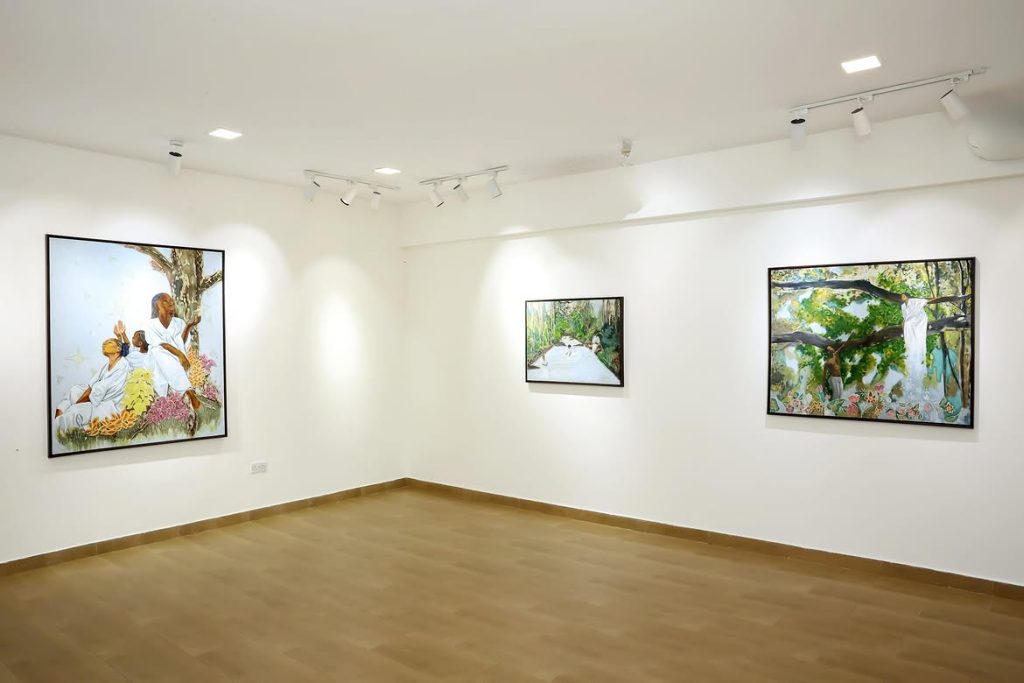
Now set against the Belo-Osagie collection at the Yemisi Shyllon Museum, the question moves beyond conceptual discussion into practical expression. At the museum opening, Dr. Myma Belo-Osagie recounted how her journey into collecting began from a feeling. She had been a student far from home, desiring some form of connection, and that pull towards a way of seeing presented art as the medium through which the connection could be had. Whether a conscious rationalisation led to the decision or an unconscious inspiration prompted it, that receipt of what was given has grown into a substantial collection of art, conditioned her family towards appreciating art, and now, decades after the first singular acquisition, has made the conditions for a platform for discovering, developing and celebrating young artists, which ultimately contributes to the expansion of our collective memory and consciousness. The Belo-Osagie collection is itself an act of custody: someone received, held, and now redistributes, on one hand through the forward propagation of collective artistic expression in the Myma Art Prize platform, and on the other in the public invitation to experience a history of art through the exhibition of selected works curated from the family’s collection. Interestingly, the Yemisi Shyllon Museum itself is a product of that same thing for art—That famous feeling. In an interview snippet shared on his Instagram page, Prince Yemisi Shyllon spoke about how he started collecting art as a student to satisfy an interest he felt, a humble act that has now grown into 50 years of collection and a grand museum.
In a different register but a similar fashion, A Thing For Art, and whatever impact it is now making through its dedication to discovering, developing and distributing African art, especially young emerging artists, began from a feeling Edmund Olotu had 10 years ago and how he received that feeling. In the decade of building his private collection and the eighteen months since the platform became a formal entity, doors have opened for several artists, not just in economic transformation, though there has been that, but in the deeply felt validation and celebration of artistic thought and expression that inspires an artist towards much, much more. That thing for art, that feeling, led to ATFA’s inaugural exhibition in partnership with Yenwa gallery and the Art hotel, showing Sheriff Feyisitan whose philosophy has since grown to impress on hearts and minds locally and internationally. As creative director of ATFA, I have days when the fuel for my belief in the vision is Sheriff’s acknowledgement that A Thing For Art changed his life; in that moment the custodian is the one receiving the gift. Since Sheriff, there has been Hope Monday, Damola Adewole, Chikosolu Efobi, Ashiata Shaibu, Adamu Farouk, Damilola Opedun and most recently, Azeez Muritadoh. The sentiment may vary across the rest of the artists we have supported through residencies, salons, gallery introductions and collector introductions, but the growing roster of influential artistic voices that have enjoyed ATFA’s contribution, in one form or another, on their journey to acclaim renews my conviction.
Language, memory and the labour of the hands before us give perspectives, ideas and inspirations, and artists, as the bridges between what has been handed down and what society can now take up, receive them and translate them. Those who have been given the creative attention to notice and value these translations are bound by the same mandate as the artist, which is to dispense, to the best of our ability, what we have received. That is our charge.