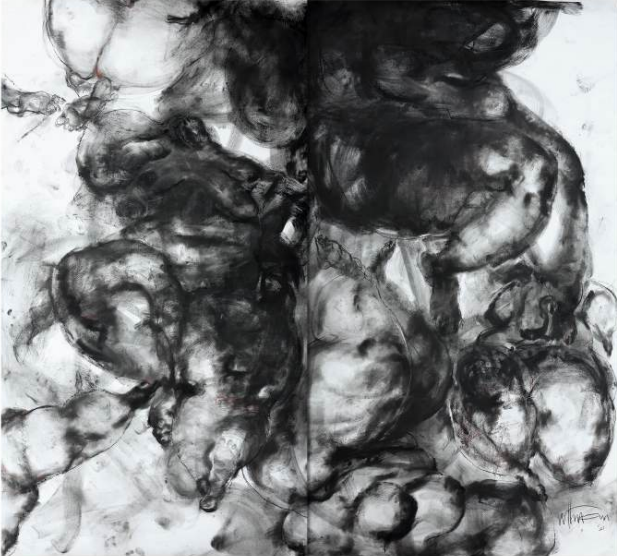
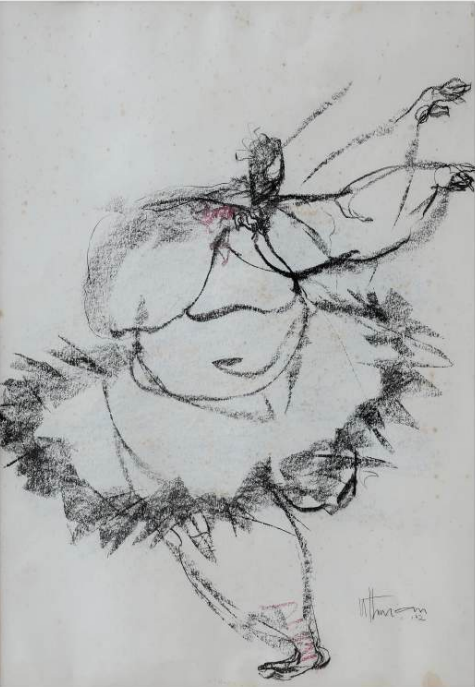
What’s more delusional than a fat ballerina? By all natural and imposed requirements or expectation of the performance, a fat ballerina is almost an impossible image so to create one, to be one, would demand a considerable amount of delusion. Alas We Meet Again is Uthman’s recently concluded solo exhibition at Windsor Gallery and it is a graphic class act for a contemporary conversation that is becoming more and more pertinent in today’s world. Artistically speaking, my favorite pick of the series is the Soft monument but as far as I’m concerned, the best piece of the collection is the Fat ballerina.
There’s a saying that no one gets out of life alive but many people never even get in — they exist without living, and fewer still thrive. The human condition requires a measure of delusion to be fully inhabited. The fat ballerina tells this whole story in a few strokes of charcoal on paper, and that economy is part of what makes her exceptional.
The fat ballerina has accepted the bulk of herself and chosen, from that acceptance, to chart a story of her own — a seemingly impossible belief in the fullness of self available to her even beyond a single narrative. She must have reclaimed her power from shame, from the fear of failure, from the small comforts of self pity so as to be light and graceful on her feet. She must have understood that she is both audience and performer, and so has no care for impressions that would negate what she already believes of herself ; she knows who she is regardless of the apparent reality.
The path to knowing oneself is never an easy road. It is one that requires acceptance but demands ambition, and ambition is a steep climb. The climb requires a lot of letting go and so most people choose instead to remain in the valley of acceptance. But as is the rule with all things, nothing that stops moving stays well; a state that does not flow eventually sours. The responsibility of being human is the responsibility to keep expressing more of oneself — the need to become more. A human that is alive never stops being.
Too many people today have stopped becoming, which is exactly why a conversation like this one belongs in public discourse. They are on a self-imposed pause, waiting for something before they permit themselves to live — a different version of themselves, the meeting of some goal, the validation of an audience, or perhaps even the sheer lack of belief in their potential to have life and have it more abundantly. They have entered into a kind of bondage to a master who is never present and never satisfied, a master who keeps them from becoming anything at all, let alone becoming themselves.
Of all the works presented in this show, the fat ballerina embodies the curatorial question most completely: What happens when one returns to themself and embraces every fragment of their humanity without shame?
She understands that this return is an act of courage — it means confronting the identities other people’s expectations have shaped, and the imprints left by every experience that has touched her life. She embodies the idea that liberation is not the absence of contradiction but the freedom to hold it: to inhabit oneself without shame, to want without fear, to carry memory without being defined by it, and to let every version of a self — the confident and the uncertain, the whole and the fragmented — have the right to exist.
Somewhere in the weight she carries and the lightness she insists on anyway is the whole argument of this show, made in charcoal, and expressed in a form no one expects to dance. The fat ballerina is special because it captures a foundational picture of how to be human.