
NIGERIAN ROYALTY SERIES
Olu Atorongboye
Sebastian I · Sixth Olu of Warri · r. c. 1597–1624/25 South-South Zone · Niger Delta · Warri Kingdom
The Niger Delta does not yield easy geography. It is a world assembled from water — Forcados, Escravos, Benin River, a thousand unnamed channels threading through mangrove and clay-bank, each tide redrawing the boundary between land and sea. To rule here was not to hold a fixed line; it was to hold a relationship — with water, with trade, with the powers that moved across it. The Itsekiri people had understood this for centuries. When Atorongboye ascended the throne around 1597, he understood it more acutely than most.
He was born Prince Eyomasan, within the sixth generation of the Warri dynastic line, itself descended from the Benin royal house. The founding figure, Prince Ginuwa, had left Benin in an iroko-wood ark around 1480 — by oracle, by calculated departure, by the irresolvable tensions between a dynasty’s ambitions and its customs, depending on who tells the story — and settled at Ijala, where the Itsekiri people received him and made him their first Olu. His successors had moved the capital to Ode-Itsekiri, unified the scattered coastal communities, and by the mid-sixteenth century were trading with the Portuguese independently of Benin. A Benin-descended dynasty, building a non-Benin future. It was this particular inheritance — deep roots, new trajectories — that Atorongboye received and then deepened beyond recognition.
He had been baptised before he was king. Sometime during his father Esigie’s reign, the Augustinian friar Francisco a Matre Dei — one of the missionaries sent to Warri by the Bishop of São Tomé after the Augustinian mission launched around 1571 — baptised the Itsekiri prince under the name Sebastian. Whether the moment was solemn or political or simply the natural outcome of a court that had opened its doors to Portuguese priests, no record says. What matters is what he did with it when the throne came to him. He did not store the baptism away as a diplomatic gesture. He built a reign from it.
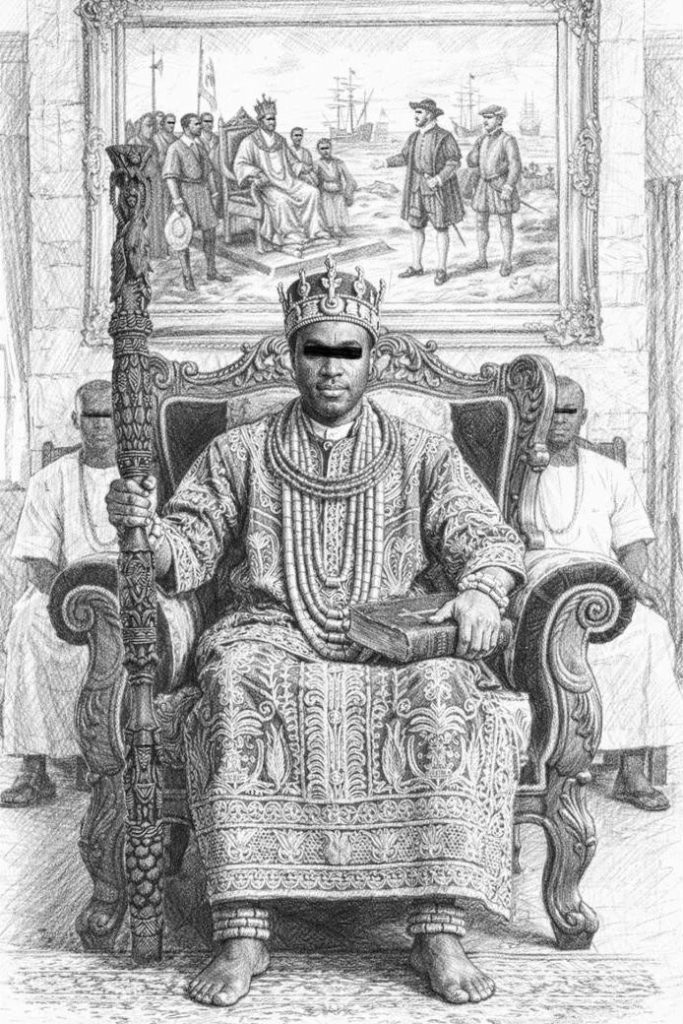
Sebastian was the name he wore in the Atlantic world. Atorongboye was the name he wore at home. He ruled under one and corresponded under the other, and he appears to have seen no contradiction in this — because there was none. The Benin-origin dynasty had always combined inherited form with new ambition. Atorongboye was merely its most eloquent expression. He upheld the chiefly hierarchy, maintained the Itsekiri ceremonial structure, buried his predecessors at Ijala according to custom, and when he himself died, a tree was planted there in his honour, as it had been for every Olu before him. At the same time, he invited a bishop to reside in Ode-Itsekiri, cultivated his court’s literacy in Portuguese, and opened his palace to books, ink, and paper in a way that made a later ecclesiastical visitor remark on it with something like surprise. By 1620, the Augustinian Bishop Pedro da Cunha would record in his official report to Rome that the people of Warri knew how to read and write and were eager for Portuguese books. This was not an accident of mission. It was the culture of a specific court, shaped by one specific king.
The larger world was reorganising itself around him. When Atorongboye came to the throne, Portugal and Spain had been joined for nearly two decades under the Habsburg crown — Philip II had secured the Portuguese throne in 1580, and his son Philip III continued the Iberian Union that made the two empires effectively one. For a baptised Christian king on the Forcados River to cultivate ties with the Habsburg monarchy was not merely a gesture of piety; it was an entry into the most powerful diplomatic system of the age. Portuguese sources treated Atorongboye as what he was: a sovereign Christian monarch. Not a chieftain converted for convenience, not a subordinate. A king in correspondence with kings. This recognition was leverage — in trade, in regional standing, in the long complicated shadow cast by Benin over any polity that bore its dynastic bloodline.
— — —
But his most deliberate act — the one that would outlast everything else about his reign — was the dispatch of his heir.
Around 1600, Atorongboye sent his son Prince Oyeomasan to Portugal to study. The prince enrolled first at the Colégio de São Jerónimo in Coimbra — the city that housed one of Europe’s oldest universities — where his annual stipend was met from the Portuguese royal treasury at Philip III’s personal instruction. The official rationale, as framed in a letter to the king, was precise: the prince had been sent so that he could help in the conversion of his people and also to govern his kingdom well. It was not an either/or. The education was spiritual and civic at once, and Atorongboye had been clear enough about both purposes that the crown’s own correspondence captured them faithfully.
What followed was eleven years of formation. The prince moved through Coimbra, then to the Augustinian college in Lisbon, then to a Jesuit school. He became fluent in the Portuguese of theology, law, and diplomacy. He secured improved trade terms for Warri directly from the Habsburg king. And in June 1610, in Lisbon, he married a Portuguese noblewoman, Maria Pereira, before returning home the following year. When he eventually ascended the throne as Olu Atuwatse I, he became the first sub-Saharan African to graduate from a Western university — a distinction the historical record still honours. He also commissioned the silver crown, topped with the cross of Christ, that remains the crown of the Warri Kingdom to this day.
The son’s achievements are Atorongboye’s achievement. Not because the father did the work, but because he built every bridge the work required.
— — —
He held a bilateral commitment — to Portugal across the Atlantic, to the Itsekiri beneath his feet — for nearly a quarter century, without either collapsing. He kept his son in Europe for eleven years during a period when the slave trade was expanding along the very coast where Warri sat, when missionary credibility was being corroded by the gunboats that carried priests alongside their Bibles, when broader Itsekiri society remained resistant to conversion and the Forcados River had already become a corridor for the worst commerce of the age. The Christian identity he cultivated did not cascade outward into mass transformation. It remained a dynastic commitment — deep, durable, and deliberately maintained. For nearly two and a half centuries after his reign, every Olu was baptised. The faith became constitutional to the monarchy, not because a people were converted, but because a king decided it would be.
Atorongboye governed a small deltaic kingdom of waterways and creeks. The Itsekiri homeland was no empire. But the terms on which it entered the early Atlantic world, the intellectual preparation it gave its ruling dynasty, the centuries of commercial and diplomatic advantage it derived from being first to understand what European literacy and Christian legitimacy meant in a reorganising world — all of that traces a line back to one reign. And to the two names one man was willing to carry simultaneously.
— — —
He thought transcontinentally from the edge of a mangrove. He prepared his son for a university he would never see. He held Itsekiri tradition and Atlantic modernity in both hands and refused to drop either.
That steadiness is the monument. Not a crown, though there is one. Not a tree at Ijala, though one was planted. The monument is a son who returned from Coimbra with a Portuguese wife, a university degree, and trade terms he had negotiated personally with a Habsburg king — because his father had understood, decades earlier, that the world was changing, and that the only kingdoms that would shape their own future were those that sent their heirs to meet it.